Home › Artificial Intelligence › History of Artificial Intelligence
History of Artificial Intelligence
2026-10-10 · Pacific Gyan · 5 min read
The history of Artificial Intelligence spans over seven decades, moving from abstract mathematical inquiries and mechanical chess experiments to modern deep learning and large multimodal models.
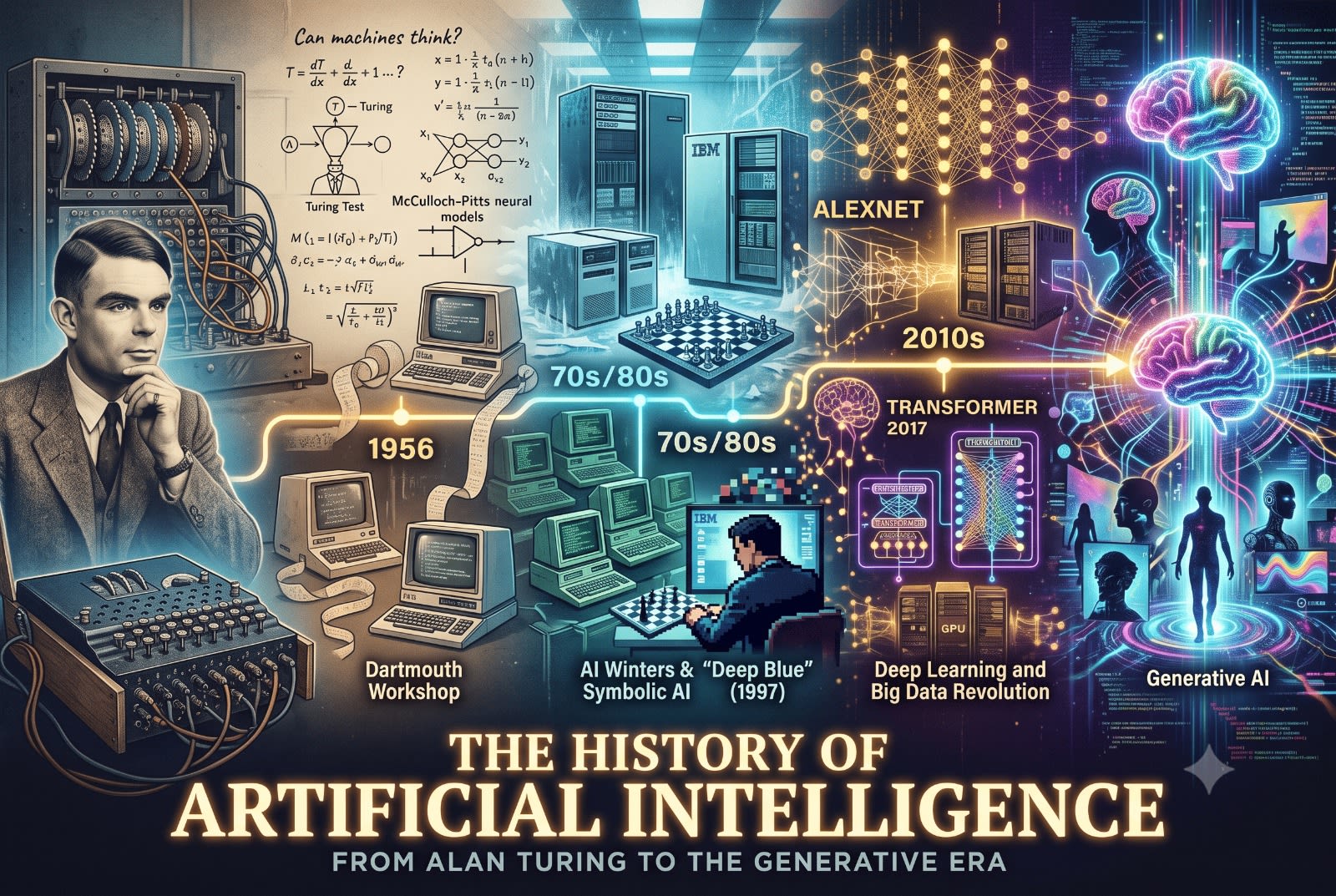
1. The Foundations & The Turing Era (1936–1955)
The theoretical framework for AI began with foundational logic and wartime computation:
- The Universal Machine (1936): Alan Turing introduced the concept of the Universal Turing Machine, demonstrating that a single abstract machine could execute any algorithm by manipulating symbols on a strip of tape.
- Early Artificial Neurons (1943): Neurophysiologist Warren McCulloch and logician Walter Pitts published a mathematical model of an artificial neural network, proving that networks of binary threshold switches could compute basic logical functions (AND, OR, NOT).
- "Computing Machinery and Intelligence" (1950): Turing opened this landmark paper in the journal Mind with the question: "Can machines think?" Instead of debating consciousness philosophically, he proposed the Imitation Game (later named the Turing Test): if a human interrogator communicating strictly through text cannot reliably distinguish a machine from a human, the machine can be said to exhibit thinking behavior.
- Early Game Programs (1951–1952): Christopher Strachey wrote an early checkers program on the Manchester Mark I, and Arthur Samuel began developing a self-improving checkers engine at IBM that learned positional advantages through practice.
2. The Birth of the Field & Golden Years (1956–1974)
- The Dartmouth Workshop (1956): Organized by John McCarthy, along with Marvin Minsky, Nathaniel Rochester, and Claude Shannon, the Dartmouth Summer Research Project on Artificial Intelligence coined the term "Artificial Intelligence" and formally established it as an academic discipline.
- Logic Theorist & General Problem Solver (GPS): Allen Newell, Herbert Simon, and Cliff Shaw demonstrated that machines could perform automated theorem proving, successfully proving 38 of the first 52 theorems in Whitehead and Russell’s Principia Mathematica.
- Early Symbolic Systems: Researchers focused on Symbolic AI (GOFAI — Good Old-Fashioned AI), which relied on explicit rules and tree searches. Notable programs included ELIZA (1966, Joseph Weizenbaum’s early rule-based conversational therapist) and SHRDLU (1970, Terry Winograd's natural-language manipulator in a simulated block world).
- The First Perceptron (1958): Frank Rosenblatt built the Perceptron hardware, demonstrating linear classification. However, early connectionism was severely constrained by single-layer limitations.
3. The First AI Winter (1974–1980)
Unrealistic early forecasts collided with structural technical bottlenecks:
- Minsky and Papert's Critique (1969): In their book Perceptrons, Marvin Minsky and Seymour Papert mathematically proved that single-layer perceptrons could not solve linearly non-separable problems (such as the XOR function). This cooled enthusiasm for neural network research for over a decade.
- Combinatorial Explosion & Hardware Limits: Symbolic search trees grew exponentially beyond the storage and processing capacities of 1970s mainframes.
- Funding Collapse: In 1973, the UK’s Lighthill Report concluded that AI had failed to achieve its promised grand objectives. Simultaneously, DARPA in the United States sharply curtailed basic research grants, triggering the First AI Winter.
4. The Expert Systems Boom & The Second Winter (1980–1993)
- The Rise of Expert Systems: Instead of trying to construct general human intelligence, researchers engineered narrow, rule-based systems encoding specialized human domain knowledge (such as DENDRAL for chemical analysis, MYCIN for medical diagnostics, and XCON/R1 for DEC computer configuration).
- Commercialization & Specialized Hardware: Corporations invested heavily in custom LISP machines (from Symbolics and LMI) and the Japanese government launched the well-funded Fifth Generation Computer Systems initiative in 1982.
- Backpropagation Rediscovered (1986): David Rumelhart, Geoffrey Hinton, and Ronald Williams popularized the backpropagation algorithm for training multi-layer neural networks, overcoming the earlier XOR bottleneck.
- The Second AI Winter (1987–1993): Expert systems proved brittle, expensive to maintain, and incapable of out-of-distribution reasoning. Concurrently, general-purpose microprocessors from Intel and Sun Microsystems surpassed specialized LISP machines, leading to an industry crash and widespread venture failure.
5. Statistical Machine Learning & Deep Blue (1993–2011)
During the 1990s and 2000s, the discipline abandoned hand-crafted heuristic logic in favor of probabilistic modeling, empirical data, and statistical machine learning:
- Deep Blue Defeats Kasparov (1997): IBM’s Deep Blue supercomputer defeated World Chess Champion Garry Kasparov in a six-game match, combining customized parallel search hardware with sophisticated evaluation functions.
- Dominance of Statistical ML: Support Vector Machines (SVMs), Random Forests, Hidden Markov Models (for speech processing), and Bayesian networks became the predominant standards across academia and industry.
- Autonomous Milestones: The 2005 DARPA Grand Challenge saw autonomous vehicles successfully navigate 132 miles of desert terrain, proving the viability of sensor-fusion algorithms.
- Deep Belief Networks (2006): Geoffrey Hinton, Ruslan Salakhutdinov, and Yoshua Bengio introduced layer-wise pre-training for deep belief networks, initiating the revival of connectionism under the moniker Deep Learning.
6. The Deep Learning Revolution (2012–2020)
Between 2010 and 2012, three critical factors converged: massive internet datasets (ImageNet), parallelized graphics processing units (GPUs), and refined optimization algorithms:
| Milestone / Architecture | Year | Core Significance |
|---|---|---|
| AlexNet | 2012 | Alex Krizhevsky, Ilya Sutskever, and Geoffrey Hinton won the ImageNet contest by a wide margin using deep Convolutional Neural Networks (CNNs) trained on NVIDIA GPUs. |
| Generative Adversarial Networks (GANs) | 2014 | Ian Goodfellow introduced competitive generator-discriminator setups, enabling high-fidelity image and media synthesis. |
| AlphaGo | 2016 | Google DeepMind combined deep neural networks, Monte Carlo Tree Search, and reinforcement learning to defeat 18-time world Go champion Lee Sedol. |
| The Transformer Architecture | 2017 | Vaswani et al. published "Attention Is All You Need", discarding recurrent structures in favor of self-attention mechanisms. |
| Early Foundation Models | 2018–2020 | BERT (bidirectional encoders) and OpenAI's GPT-1, GPT-2, and GPT-3 established the effectiveness of autoregressive next-token pre-training at scale. |
7. Generative AI, Large Multimodal Models & Frontier Systems (2021–Present)
- Consumer Mainstreaming: In late 2022, OpenAI launched ChatGPT (incorporating Reinforcement Learning from Human Feedback, RLHF), making conversational models accessible to a global audience.
- Multimodal Integration: Modern models (such as GPT-4, Google Gemini, Anthropic Claude, and open-weight architectures like Meta’s Llama series) natively parse and generate code, text, high-resolution imagery, audio, and video in unified pipelines.
- Chain-of-Thought & Inference-Time Compute: Modern systems incorporate test-time reinforcement learning and search paradigms (such as OpenAI's o-series and DeepSeek-R1), spending dynamic compute at inference to solve complex mathematical, coding, and scientific reasoning tasks.
- Academic Recognition: In 2024, the Nobel Prize in Physics was awarded to John Hopfield and Geoffrey Hinton for foundational discoveries in artificial neural networks, while the Nobel Prize in Chemistry went to Demis Hassabis and John Jumper for predicting protein structures with AlphaFold.